Key Points
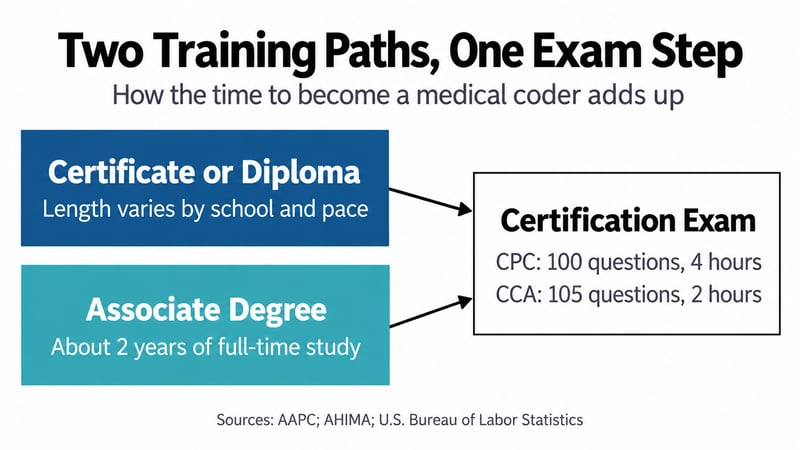
- Certificate and diploma programs vary in length by school and pace; associate degree programs run about two years of full-time study.
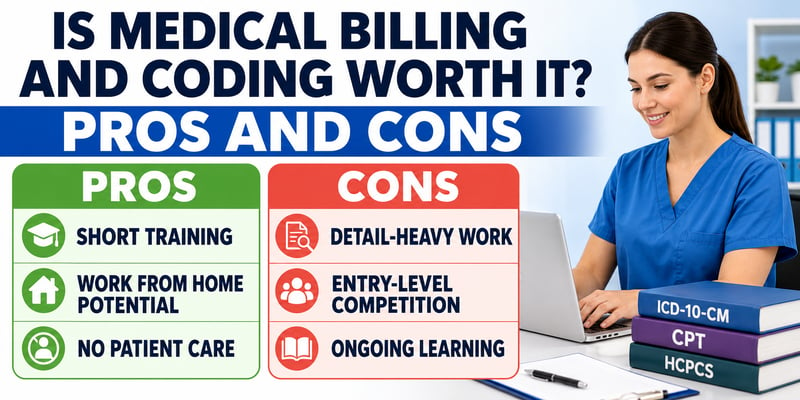
- The work is detail and memorization heavy (medical codes, payer rules) rather than physically demanding.
- The work is computer-based, and remote and work-from-home roles exist, though experience requirements vary by employer.
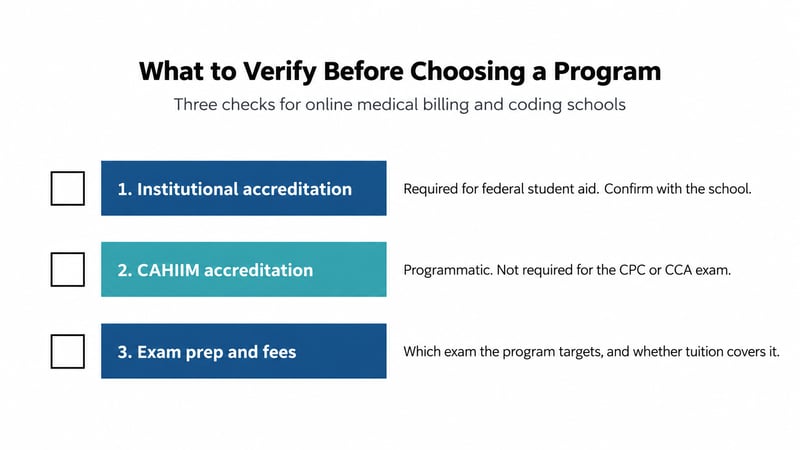
- Federal financial aid depends on the school's institutional accreditation; CAHIIM is a separate programmatic accreditor, and the CPC and CCA exams do not require a CAHIIM program.

What Do Medical Billers and Coders Do?
Medical billers and coders turn the record of a patient visit into the information insurers need to pay for it. The work happens behind the scenes, in front of a computer, rather than in direct patient care.
The job has two halves:
- Coding reads the provider's documentation and assigns standardized codes: ICD-10-CM for diagnoses, CPT for procedures and services, and HCPCS Level II for supplies, equipment, and some services not covered by CPT.
- Billing builds the claim from those codes, sends it to the right payer, tracks the response, and follows up on denials.
Some employers combine both jobs in one position, while larger organizations may separate them. Either way, the codes also become part of the patient's medical record, so accuracy matters for recordkeeping and compliance, not only for payment. The Bureau of Labor Statistics notes that medical records specialists must interpret medical documentation to assess diagnoses and must act ethically when handling patient data.
How Long Does It Take to Become a Medical Coder?
The time it takes to become a medical coder has two parts: a training program, then a certification exam on top of it.
- Certificate or diploma program. The Bureau of Labor Statistics says medical records specialists typically need a postsecondary certificate to enter the occupation. Length depends on the school, the number of courses, and whether you study full time or part time, so compare the stated length of each program rather than relying on one industry-wide range. Each program listing on Dreambound shows its length and format, which makes that comparison direct.
- Associate degree. An associate degree is designed as about two years of full-time study. BLS notes that some positions might call for one.
Certification adds study and exam time after, or near the end of, the program. BLS says employers may prefer to hire certified candidates. The two main certifying bodies are:
- AAPC, which offers the Certified Professional Coder (CPC) exam: 100 questions in four hours, with 70 percent needed to pass. Candidates without two years of coding experience earn the CPC-A apprentice designation, which is removed once the experience is documented.
- AHIMA, which offers the Certified Coding Associate (CCA) exam, open to anyone with a high school diploma, and the Certified Coding Specialist (CCS), for which coding experience is recommended but not required.
For a closer breakdown of each path, see how long it takes to become a medical biller and coder.
Is Medical Billing and Coding Hard?
Medical billing and coding is hard in a mental sense, not a physical one. There is no lifting or patient handling. The difficulty is in learning thousands of codes across ICD-10-CM, CPT, and HCPCS, and the logic that decides which code applies. Two diagnoses can sound alike and carry different codes, and the documentation has to support every code you assign.
Attention to detail carries real weight. A wrong digit or a missing modifier can lead to a denied claim, a delayed payment, or a compliance problem for the provider.
The certification exam is a separate hurdle from the coursework. The CPC exam asks 100 questions in four hours with a 70 percent passing score, so it tests speed as well as accuracy. The CCA exam has 105 questions and a two-hour limit.
Learning does not stop after certification. Code sets are revised on a regular schedule, and payer rules change with them. Keeping a credential active also requires continuing education:
- AAPC requires 36 continuing education units (CEUs) every two years for one certification.
- AHIMA requires 20 CEUs every two years for the CCA or CCS.
So is billing and coding hard? It suits people who are comfortable with careful, repetitive analysis and steady study, and it can wear on people who prefer varied, hands-on work.
Is Medical Billing and Coding Worth It?
The answer to whether medical billing and coding is worth it depends on how the training time, the pay, and the day-to-day work line up with what you want.
The Case For It
- A shorter path into healthcare. BLS lists a postsecondary certificate as the typical entry education, which means less time in school than healthcare careers that require a degree.
- Computer-based work. The work happens at a computer, and remote and work-from-home positions exist for billers and coders.
- Steady demand. BLS projects 8 percent employment growth for medical records specialists from 2025 to 2035, much faster than the average for all occupations, with about 14,000 openings a year. BLS ties that demand in part to an aging population that needs more medical services.
- No direct patient care, for people who want to work in healthcare without clinical duties.
The Trade-Offs
- Competitive entry. Entry-level positions can be competitive in some markets, and a new CPC holder carries the apprentice designation until the experience requirement is met.
- Continuing education. Credentials stay active only with ongoing CEUs, because codes and payer rules keep changing.
- Pay growth is not automatic. BLS publishes no pay data by coding specialty or certification, so treat claims that one credential pays more with caution. The federal data does show pay differences by work setting.
- Automation. BLS notes that wider adoption of AI-powered tools may affect demand for these workers, which puts more weight on judgment-heavy work such as complex cases and denials.
Accredited Online Medical Billing and Coding Schools With Financial Aid
Dreambound is a marketplace that lists vocational programs from schools across the country, so you can line up length, format, and credential before contacting any school. Whichever programs you compare, check three things.
- Institutional accreditation, for financial aid. To offer federal student aid, the U.S. Department of Education requires that a school be accredited by a nationally recognized accrediting agency. This is accreditation of the whole school. Ask the financial aid office whether the specific program you want qualifies for federal aid before you file the FAFSA.
- CAHIIM accreditation, for the program itself. CAHIIM, the Commission on Accreditation for Health Informatics and Information Management Education, is the programmatic accreditor for health information management and health informatics education. It accredits health information management and health informatics degree programs, and it accredits certificates in areas that include medical coding. Its Program Directory lists accredited programs. CAHIIM accreditation is separate from the school's institutional accreditation, and it is not required to sit for the CPC or the CCA.
- Exam preparation and fees. Find out which exam the curriculum targets and whether tuition covers the exam fee. For reference, the AAPC core exam fee is $425 for one attempt, and the AHIMA CCA exam fee is $199 for members and $299 for non-members.
For more on formats and what online study involves, see online medical billing and coding classes.
How Much Do Medical Billers and Coders Make?
According to the Bureau of Labor Statistics, medical records specialists (SOC 29-2072), the federal occupation that covers medical billers and coders, earned a median annual wage of $51,140 in May 2025, or $24.59 an hour. The lowest 10 percent earned less than $37,000, and the highest 10 percent earned more than $81,150.
Work setting moves the median. In May 2025, BLS reported these medians by industry:
- Management of companies and enterprises: $60,980
- Hospitals: $59,120
- Administrative and support services: $49,490
- Offices of physicians: $47,120
- Professional, scientific, and technical services: $46,800
BLS does not publish wages by certification or by coding specialty, so federal data cannot show how much a specific credential changes pay. Treat certification as a way to qualify for a wider set of postings, not as a predictor of pay.