Key Points
- Critical care nurses are RNs, and BLS reports a $97,550 median for all RNs in May 2025 because it doesn't track ICU nurses as a separate group.
- ICU work alone doesn't guarantee higher pay, since acute and critical care nurses earned the same $80,000 median as RNs overall in NCSBN's 2022 workforce survey.
- The CCRN certification requires 1,750 hours of direct care for critically ill patients over two years, and some employers reward it with bonuses or raises.
- California pays RNs the most even after adjusting for living costs, while Florida drops to last once prices are factored in.
- One year of full-time critical care experience is the minimum for nurse anesthesia programs, which lead to a role with a $236,590 median.
How Much Does a Critical Care Nurse Make?
A critical care nurse makes about the same as other RNs at the median. BLS puts the median RN salary at $97,550 a year in May 2025, with the lowest 10% earning less than $68,940 and the top 10% earning more than $137,470, according to the BLS Occupational Outlook Handbook. Those figures include ICU nurses, but BLS doesn't break them out.
Job sites give a wider range, and the job title you search changes the answer. ZipRecruiter estimates critical care nurse pay at $94,610 a year as of October 13, 2026, while its estimates for "ICU registered nurse" and "ICU nurse" titles come in at $118,725 and $85,205. Indeed's ICU registered nurse page shows an average of $2,110 a week, plus about $12,375 a year in overtime, based on 89,700 salaries from job postings.
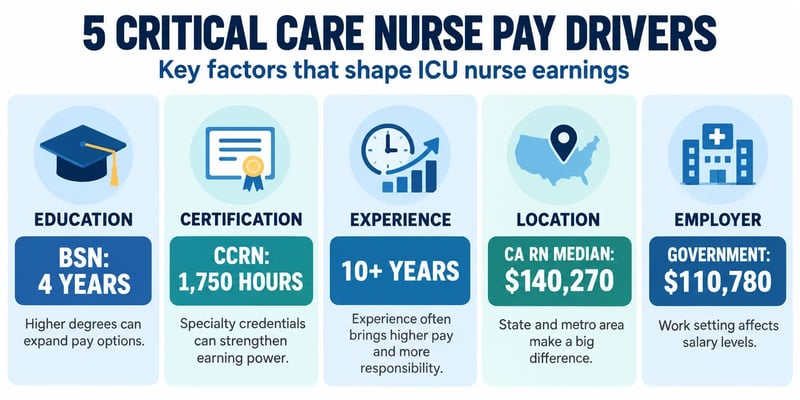
So, do ICU nurses earn more? Not automatically. In the NCSBN 2022 National Nursing Workforce Survey, acute and critical care nurses reported a median of $80,000 a year, the same as RNs overall that year. Higher ICU pay tends to come from the factors below.
Critical Care Nurse Hourly Wage
The median RN hourly wage is $46.90 in BLS data, and ZipRecruiter's critical care nurse estimate works out to $45.49 an hour. On Payscale, where nurses report their own pay, the average for critical care RNs is $39.18 an hour, based on 6,358 profiles.
Base hourly rates leave out a lot of what ICU nurses earn, since night, weekend, and critical care differentials, overtime, and certification pay all sit on top of the base rate.
Education and Certifications
Your degree sets your starting point. Most critical care units are in hospitals, and BLS notes that employers, "particularly those in hospitals," may require a bachelor's degree. Our registered nurse salary guide covers how ADN and BSN pay compare in BLS data.
Self-reported survey data shows pay rising with each degree. In NCSBN's 2022 survey, RNs reported these median earnings by highest nursing degree:
- Associate degree: $70,000
- Bachelor's degree: $75,000
- Master's degree: $100,000
- Doctor of Nursing Practice (DNP): $110,000
The jump at the master's level partly reflects advanced roles such as nurse practitioner, which require graduate degrees. NCSBN's 2024 survey raised the overall RN median to $88,000, from $80,000 in 2022, but its public summary doesn't include the newer breakdown by degree. If you're comparing bachelor's programs, see BSN programs near you.
CCRN and Other Critical Care Certifications
The best-known ICU credential is the CCRN from the AACN Certification Corporation, offered for adult, pediatric, and neonatal critical care. According to the CCRN exam handbook, you qualify through one of two clinical-hours options:
- 1,750 hours of direct care for acutely or critically ill patients in the past two years, with 875 of those hours in the most recent year
- 2,000 hours over the past five years, with 144 of those hours in the most recent year
The exam costs $260 for AACN members and $375 for nonmembers. It has 150 questions, 125 of them scored, and a three-hour time limit. The credential lasts three years, and renewal takes 432 hours of direct care in that period, 144 of them in the final year, plus 100 continuing education points.
Certification is far from universal. As of December 31, 2021, about 172,720 RNs held a critical care certification, or 4.0% of all RNs, according to the HRSA National Sample Survey of Registered Nurses.
The pay effect depends on your employer. In Nurse.com's 2024 salary report, 40% of nurses who earned a certification said they received a salary increase. Some public employers publish their policies. Los Angeles County's health department, for example, lists a $1,000 one-time bonus for national board certification and up to $500 in exam reimbursement for its RNs.
AACN offers related credentials, too. The PCCN covers progressive care for adult patients, such as step-down units, with the same hour requirements and fees as the CCRN. The CMC and CSC are cardiac and cardiac surgery subspecialty credentials that you add on top of an existing specialty certification, at $150 for members and $240 for nonmembers.
If you're an RN with an associate degree, Dreambound lists online RN-to-BSN programs you can compare.
Years of Experience
Experience has one of the clearest effects on pay. BLS doesn't publish wages by years on the job, but Payscale's self-reported data for critical care RNs shows average hourly pay climbing at each career stage:
On these figures, late-career critical care nurses average about 54% more per hour than nurses in their first year. Payscale's entry-level page was last updated in March 2025, and self-reported averages run below the BLS median for all RNs, so use the ladder for the size of the climb more than for exact pay.
Experience also unlocks the other pay drivers. You need clinical hours to sit for the CCRN, and nurse anesthesia programs require at least a year of full-time critical care work before you can apply.
Location and Cost of Living
State makes a big difference in RN pay. The median runs from $140,270 in California to $77,080 in Alabama, a difference of $63,190 a year, based on BLS data for May 2025.
Living costs narrow that gap but don't erase it. Adjusted with the Bureau of Economic Analysis's 2024 regional price parities, California still ranks first, with pay worth about $126,700 in an average-priced state. New Mexico climbs from 24th to eighth, while Florida falls from 34th to last, since its prices sit above the national average and its RN median does not.
Critical Care Nurse Salary by State
BLS doesn't report ICU nurses by state, so this ranking uses the median for all RNs, which includes critical care nurses, sorted by cost-adjusted pay.
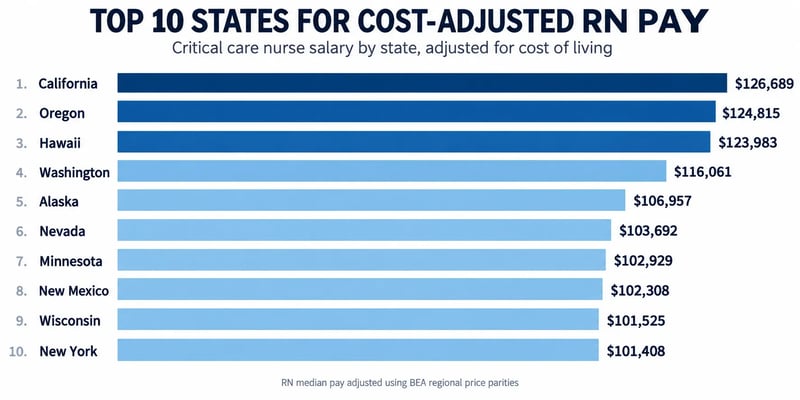
Source: BLS Occupational Employment and Wage Statistics, May 2025; cost adjustment based on BEA 2024 regional price parities.
Employer Type and Industry
Most ICU jobs are in hospitals, where the median RN salary is $100,220, compared with $84,300 in nursing and residential care facilities. Federal jobs pay especially well: RNs in the federal executive branch, which includes the Department of Veterans Affairs (VA), earned a median of $121,260 in May 2025. Under federal law, VA nurse pay has to be competitive with what non-VA health care facilities pay in the same local labor market.
Staffing agencies sit lower on base pay. RNs employed in employment services, the BLS industry that includes staffing agencies, earned a median of $90,840 in May 2025, though travel contracts often add tax-free stipends that BLS doesn't count. Our guide to travel nurse pay explains how those packages work.
Shift Differentials and Overtime
Differentials matter for ICU nurses because critical care runs around the clock, and public employers publish theirs:
- The VA adds 10% of base pay for night work, covering the whole shift when at least four hours fall between 6 p.m. and 6 a.m., plus 25% for weekend work, and double pay for holidays, and it pays overtime at time and a half, under VA nurse pay rules.
- Riverside County, California, pays per diem RNs a $4 hourly critical care differential for all hours in units such as adult ICU, PICU, NICU, and trauma, and RNs at its county health system get $5 an hour for nights, under its 2025 to 2027 labor agreement.
- Los Angeles County lists evening differentials of $3 an hour and night differentials of $4 an hour for its RNs.
Here's how differentials stack on a $46.90 base rate, using Riverside's county health system amounts as an example: a $4 critical care differential and a $5 night differential would raise the rate to $55.90 an hour on a night shift in the ICU.
Specializations
The type of ICU you work in also shapes pay, though few sources measure it the same way. Vivian's weekly averages for travel nurse jobs in October 2026 show how pediatric and neonatal units compare with general ICUs:
- Pediatric ICU (PICU): $2,490 a week
- Neonatal ICU (NICU): $2,344 a week
- General ICU: $2,222 a week
These are travel job packages, which often include stipends, so they're best read as a comparison between units rather than as staff pay. Cardiac and cardiac surgery ICU nurses can add the CMC or CSC subspecialty credentials described above.
The biggest pay jumps come from advanced practice roles, and ICU experience is the entry ticket to one of them. Nurse anesthesia programs require at least one year of full-time critical care experience as an RN, according to the Council on Accreditation of Nurse Anesthesia Educational Programs. Nurse anesthetists earned a median of $236,590 in May 2025, and nurse practitioners earned $132,300, according to BLS. Our nurse practitioner salary guide breaks down NP pay by experience.
Featured Nursing Programs on Dreambound
Education is the pay driver you can act on first, whether you're working toward your RN license or adding a bachelor's degree to one. Dreambound brings partner nursing programs together in one place, so you can weigh format and length before you apply.